
Strategic Stakes
GeoStatecraft | August 2026

Introduction
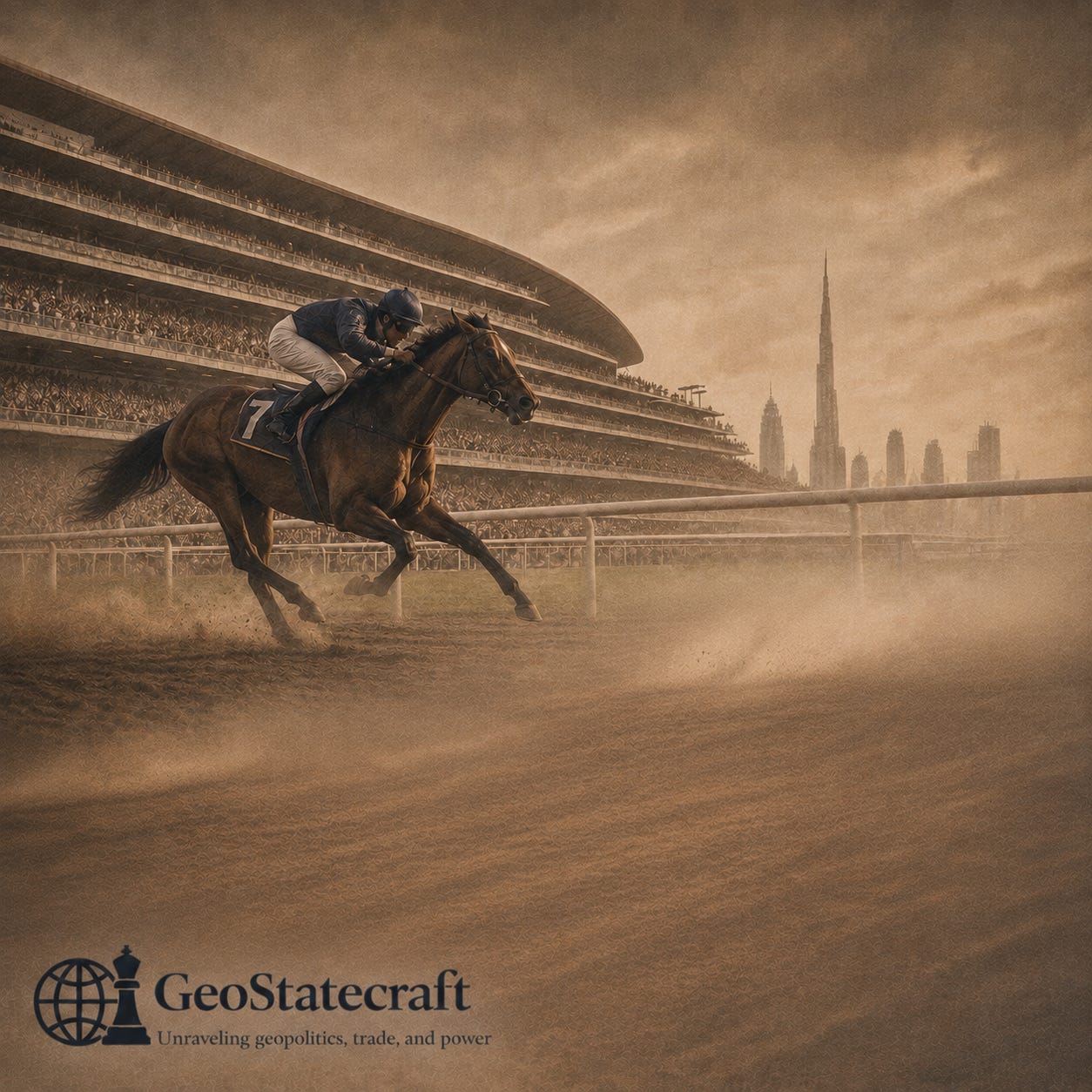
On 28 March 2026, the 30th Dubai World Cup at Meydan was staged during the first phase of the Iran war, which was set in motion with the US and Israeli strikes on Iran on 28 February and the Iranian retaliation across the region. The meeting was one of the first major international sporting events held in the region since the war began. Around 100 horses competed across nine races but the crowd was reported to be smaller than usual. The event proceeded successfully, yet the visibly reduced attendance showed that Gulf racing was already adjusting to a new risk calculus in which prestige and security had begun to share the same stage.
The impact extended to international participation. Derek Ryan withdrew Book’em Danno from the Golden Shaheen, while Shadai Race Horse Company decided that Masquerade Ball and Jantar Mantar would not travel for the Sheema Classic and Dubai Turf because of uncertainty surrounding the conflict and the safe movement of horses and personnel. Joseph O’Brien’s Aeronautic returned to Europe after racing in Dubai while the stable continued to monitor the situation. Calandagan, owned by Aga Khan Studs, ultimately travelled and won the Sheema Classic. The Dubai World Cup itself drew a nine-horse field. While Dubai Racing Club did not publish an official attendance figure, an experienced racing correspondent estimated that the crowd was nearer 15,000. The Associated Press, however, reported that it was only smaller than usual.
This leads me to explore a deeper geoeconomic story. Horse racing in the Gulf goes a long way beyond just being a sport as it is an important lever of diversification, tourism and soft power. The war exposed the industry’s hidden supply chain, from international bloodstock movements and imported feed to aviation capacity and war-risk insurance. There were repeated shifts in the strategic environment. An April ceasefire was followed by a preliminary US-Iran agreement in mid-June but hostilities resumed on 7 July. By 14 July, the United States and Iran were again exchanging attacks, maritime traffic through the Strait of Hormuz had slowed down sharply and some war insurers were advising shipowners to pause voyages. The United States had also reinstated a blockade of Iranian shipping. To understand the resilience and vulnerabilities of Gulf racing, I dissect the industry’s economic architecture, quantify its dependencies and trace the movement of geopolitical shock from horses, personnel, freight and finance to spectators.
1. The Contemporary Economy Behind Gulf Horse Racing
Horse racing has been integral to the United Arab Emirates’ diversification strategy since the 1990s. According to the Government of Dubai, the emirate’s wider sport sector contributed more than AED 9 billion, approximately US$ 2.45 billion, to the economy in 2021, equivalent to 2.3% of Dubai’s GDP and supported around 105,000 jobs. Within the equestrian economy, official UAE figures indicate that clubs spend approximately AED 367 million annually, nearly AED 2.1 billion is spent on training racehorses and the market for high-performance horse feed exceeds AED 128 million. The Dubai World Cup, whose principal race carries a US$ 12 million purse, remains the sector’s most internationally visible asset.
Tourism magnifies the economic significance. The latest official figures place travel and tourism’s contribution to the UAE economy at AED 257.3 billion in 2024, equivalent to 13% of national GDP. At the emirate level, Dubai’s latest sports strategy values the sector’s current annual contribution at AED 10.17 billion. The Dubai World Cup sits at the intersection of these two economies, supporting the demand for premium accommodation, chauffeur services, luxury vehicle rentals and helicopter tours. A 2025 Khaleej Times report noted that, by 2015, former Dubai Racing Club vice-president Frank Gabriel Jr had attributed a 30% increase in tourism to the event. This should be understood as a historical, attributed assessment of the World Cup’s cumulative contribution to Dubai tourism.
Saudi Arabia positions equestrian development with Vision 2030’s wider tourism, culture, sport and entertainment agenda. The Kingdom recorded around 116 million domestic and inbound tourists in 2024 along with nearly SAR 284 billion in tourism spending in the same year. DataSaudi reports 123 million tourists in 2025, including 29.3 million inbound and 93.3 million domestic travellers. The national target is 150 million annual visits by 2030, alongside 1.6 million tourism jobs and a contribution equivalent to 10% of GDP. The 2026 Saudi Cup weekend offered US$ 39.6 million in prize money, including US$ 20 million for the main race. At Qiddiya City, a permanent future home for the Saudi Cup is being developed with a 21,000-seat grandstand which is expandable to 70,000, dedicated turf and dirt tracks and an equine hospital.
These numbers illustrate why horse racing is more than just a “hobby” for Gulf Rulers. It is an important lever for soft power, tourism diversification and domestic employment. The prestige of hosting the world’s richest races influences how these countries are perceived globally. The industry’s scale, however, also allows shocks to reverberate widely.
2. Roots in Bedouin heritage
Horses, as a phenomenon, preceded oil wells and skyscrapers in the Gulf. Arabian horses were bred across the region for endurance, temperament and reliability in harsh desert conditions and became associated with chivalry, pride and family status. Bedouin communities relied on them for transport, conflict and survival and carefully protected valuable bloodlines. A Gulf News feature records the practice of sheltering prized horses close to the family, including inside tents. This history helps one understand the cultural intimacy surrounding the Arabian horse and the place it continues to occupy in Gulf identity.
This heritage shapes the modern economics of racing. The ruling families of the UAE and Saudi Arabia have treated breeding and racing as both strategic investments and cultural stewardship. Godolphin, founded by Sheikh Mohammed bin Rashid Al Maktoum, gets its name from the Godolphin Arabian, one of the three foundation sires of the modern thoroughbred. Sheikh Zayed bin Sultan Al Nahyan, the first ruler of the UAE, launched a breeding programme for asil, or purebred Arabian, horses at the Royal Stables in 1980. The thoroughbred races that fill the racing calendars today are built on a bedrock of cultural prestige and identity.
3. The Gulf Horse Economy: Training, Trade and Infrastructure
3.1 United Arab Emirates
The UAE operates what can best be described as an integrated racing ecosystem. A 2025 report based on Dubai Racing Club information stated that its International Department imports and quarantines around 3,000 horses annually. Sheikh Mohammed bin Rashid Al Maktoum’s Godolphin operation breeds and races horses across the world, reinforcing Dubai’s international racing brand. Equestrian clubs’ annual spending of AED 367 million and expenditure of nearly AED 2.1 billion on racehorse training anchor local demand for feed, veterinary services, logistics and employment. The market for high-performance horse feed, valued at more than AED 128 million, supports specialized nutrition manufacturers and importers.
The specialist network of infrastructure gets denser beneath these figures. The UAE has developed equine veterinary facilities, quarantine systems and dedicated airport handling capabilities. Emirates SkyCargo operates Boeing 777 freighters using purpose-built horse stalls and specialist loading equipment. In 2017, the carrier operated ten dedicated freighter flights, each configured with twenty-five horse stalls, in partnership with Peden Bloodstock. Ninety-three horses were flown from Liege to Mexico City, onward to Miami and subsequently back to Europe, while ninety-six horses and twenty-seven grooms were transported between Liege and Shanghai. The operation illustrates the aircraft configuration, ground handling and international coordination required to maintain elite equine supply lines.
Equine research, veterinary care, quarantine and digital sales are important components of this ecosystem. Specialist facilities, internationally connected racing operations and the Emirates Racing Authority’s online auction platform link clinical care, shipping, sales and competition. This integration gives Dubai a strong hub position and supports the application of common quarantine, welfare and racing-integrity standards across the industry.
Bloodstock trade is both a prestige investment and a sizeable import sector. According to the Observatory of Economic Complexity, the UAE imported approximately US$ 56.1 million worth of horses in 2024. These customs figures cover broad categories of horses and should not be interpreted as a precise measure of thoroughbred bloodstock alone. European and North American sales remain important sources of racing and breeding stock, while endurance competition also generates demand for horses from other markets.
Sales activity remained robust. The Emirates Racing Authority’s March-April 2026 online sale attracted 221 registered bidders from around the world, 154% more than the average registration for its live sales during the previous five years. Of 169 lots offered, 132 were sold, generating AED 9.57 million. A reported 93% clearance rate was achieved on the second day of the sale. A subsequent June auction sold all thirty lots for AED 2.42 million, with more than ninety registered bidders participating from ten countries. Even during conflict, capital continued to flow into UAE racing through digital channels.
3.2 Kingdom of Saudi Arabia
Saudi Arabia has spent decades expanding its equestrian infrastructure. Beyond the US$ 39.6 million Saudi Cup weekend, the Kingdom is developing Qiddiya City’s permanent racing venue, with a 21,000-seat grandstand expandable to 70,000. Al Muatadil Equestrian Village in Al Ula covers approximately 285 hectares or 2.85 square kilometres and is planned with racing, endurance and polo facilities, visitor infrastructure and two stable compounds with total capacity for 740 horses. The Royal Commission for Al Ula aims to host sixty-four equestrian events and attract 120,000 visitors annually by 2035. At Wadi Safar, the Royal Diriyah Equestrian and Polo Club is planned with a one-kilometre training track, a 1,000-seat indoor arena and stable capacity for approximately 250 horses.
Equestrian heritage is woven into Saudi society. Arabian bloodlines such as the Kuhaylan and Saqlawi retain considerable cultural significance, while the Jockey Club of Saudi Arabia stages seasonal racing at King Abdulaziz Racecourse in Riyadh and King Khalid Racecourse in Taif. The Saudi Cup sits at the summit of this domestic racing system. The sector’s evolving social role is also visible in the International Jockey’s Challenge, where seven women and seven men competed individually during the 2026 Saudi Cup weekend.
The state’s investment extends beyond racetracks. Qiddiya City combines its future racing venue with hotels, theme parks and other leisure assets. At Al Ula, Al Muatadil is designed to connect equestrian sport with heritage tourism, accommodation, retail and local employment. Taken together, these projects demonstrate a strategy to turn equestrianism into a wider economic multiplier. Horses attract visitors, longer stays support hotels and services and the resulting activity reinforces national and destination branding.
Saudi Arabia’s total horse imports are considerably larger than the narrow “other live horses” customs category sometimes cited in market reports. The Observatory of Economic Complexity reports total horse imports of approximately US$ 34.6 million in 2024. The distinction matters because HS 010129 excludes purebred breeding animals and therefore cannot be used as a measure of the Kingdom’s overall bloodstock market. Continued investment in racing, breeding and new equestrian facilities indicates that the Kingdom’s ambitions extend well beyond the movement recorded under one tariff category.
Market research also points to growth in adjacent consumer categories. A certain proprietary market research source estimates that Saudi imports of horse-riding equipment grew by 39.04% between 2023 and 2024 and recorded a compound annual growth rate of 30.12% between 2020 and 2024. While these are proprietary market estimates rather than official national statistics, they are directionally consistent with rising investment in recreational and competitive equestrian activity.
3.3 Bahrain, Qatar and Other Gulf States
Bahrain and Qatar also play important roles. The Bahrain International Trophy is scheduled to be run as a Group 1 race with a US$ 1.5 million prize fund in November 2026, highlighting the island’s growing ambition. Qatar hosts show-jumping and endurance events and, as demonstrated by the wartime evacuation from Doha, possesses the infrastructure and personnel required to manage large groups of elite horses. Data on the wider economic contribution of equestrian sport in the smaller Gulf states remains limited and their international racing profile is still less extensive than that of Dubai or Riyadh.
4. The International Horse Supply Chain
Thanks to the glamour of Gulf racing, a complex transnational supply chain remains largely hidden. Shipping a racehorse by air typically costs US$ 8,000 – US$ 30,000 per horse. For shipments into the Middle East, industry estimates place average costs at EUR 8,000 – EUR 15,000 (approx. US$ 8,700 – US$ 16,300) per horse, including quarantine. Costs depend on distance, aircraft type, stall configuration (one, two or three stalls), veterinary care, war-risk insurance and customs fees. Horses fly in specially designed jet stalls accompanied by grooms and veterinarians. Pre-flight requirements include blood tests, vaccinations, veterinary certificates and quarantine. Post-arrival, horses enter licensed quarantine yards before being moved to stables.
The physical mechanics of getting a thoroughbred onto a runway are often overlooked. Horses may undergo pre-export quarantine, diagnostic testing and post-arrival quarantine with the precise requirements and duration determined by the importing jurisdiction. They travel in purpose-built air stables known as jet stalls and are accompanied by qualified grooms and in some cases veterinarians who monitor hydration, comfort and signs of stress. International welfare guidance does not recommend routine tranquilisation. Tranquilisation should be used only when clinically necessary and under veterinary direction. On arrival, ground handlers transfer the horses into suitable road transport and quarantine facilities. A delay in testing, aircraft availability, customs clearance or ground handling can disrupt training and veterinary schedules throughout the operation.
Specialist logistics companies such as Peden Bloodstock and International Racehorse Transport coordinate these movements. For major competitions, dedicated freighter charters may be configured with individual or shared stall compartments, while logistics teams coordinate grooms, veterinary documentation, customs clearances and ground transport. Emirates SkyCargo’s 2017 operation required ten Boeing 777 freighter flights and coordination across Belgium, Mexico, the United States and China. Comparable specialist movements support major racing and equestrian events in the Gulf, although the number of flights and the value of horses involved vary considerably from one meeting to another. In some cases, dozens of flights converge in the Gulf in the weeks leading up to the races, each carrying bloodstock worth tens of millions of dollars.
Once on the ground, horses require specialized feed, imported pharmaceuticals and veterinary expertise. EW Nutrition, citing regional market data, estimated the Middle East animal and pet-feed market at US$ 53.2 billion and approximately 63 million tonnes in 2024, including 9.1 million tonnes in Saudi Arabia. These should be identified as industry estimates rather than official regional statistics. Gulf equine operations remain heavily exposed to international commodity and logistics markets because many grains, forage products, additives and veterinary inputs are imported.
The fragility of the supply chain was exposed in March 2026 when 147 elite show-jumping horses were evacuated from Doha to Liege on two specially authorised Qatar Airways Boeing 777 freighter flights carrying seventy-four and seventy-three horses respectively. The operation proceeded despite the suspension of regular air services and required emergency approvals, specialist grooms, veterinarians and coordinated cargo handling. Some stranded personnel were moved separately by road. The evacuation demonstrated that moving elite horses during a crisis requires available aircraft, veterinary clearance, landing permissions and specialised ground handling to align at very short notice.
War-risk insurance became a major cost driver across Gulf logistics, although the published percentages relate primarily to ships rather than to individual horses or equine air cargo. Reuters reported that marine war-risk premiums rose from approximately 0.25% to as much as 3% of a vessel’s value during the initial March escalation. Following renewed attacks in July, Gulf quotations rose from around 2% to nearly 3%, with some brokers warning that they could reach 5%. Industry assessments also indicated that Cape of Good Hope diversions could add ten to fourteen days to some voyages and increase freight costs substantially. These figures demonstrate the severity of the wider logistics shock that also contributed to impacting the racing industry in the region.
Feed suppliers faced similar disruptions. Simultaneous instability in Red Sea routes and the Strait of Hormuz created what EW Nutrition described as a near-complete sea-access denial scenario for some Middle Eastern agricultural imports. Its industry assessment estimated increases of 25%-60% for amino acids, 15%-40% for vitamins and smaller increases across several other feed-additive categories. Expectations temporarily improved following the mid-June US-Iran agreement but renewed attacks from 7 July again slowed traffic through the Strait of Hormuz and raised insurance and shipping costs. These figures are industry estimates rather than official price indices, but they demonstrate the potential scale of exposure.
5. The 2026 War: Supply Chain Disruptions and Market Responses
One of the Iran war’s most immediate impacts on Gulf racing was psychological as trainers questioned whether they should be shipping horses into a conflict zone. The mechanical disruptions were, however, equally significant.
5.1 Reduced Attendance and Tourism
Dubai Racing Club reported a record attendance of more than 65,000 in 2025, an increase of 18% over the previous year. No official figure was made available for the 2026 meeting, although the Associated Press described the crowd as smaller than usual. The event’s exposure to international travel is significant. A 2025 Khaleej Times report stated that 46% of that year’s ticket and package sales came from international customers and 54% from UAE-based buyers. A conservative triangulation using stadium capacity, hospitality bookings and on-site observations would put the crowd turnout decline in 2026 at anywhere between 45% to 65%.
The Saudi Cup avoided the war’s direct disruption as it was staged on 13-14 February, approximately two weeks before US and Israeli strikes on Iran began the conflict on 28 February. Its position in the calendar insulated the meeting from the initial airspace restrictions, missile attacks and severe disruption in the Strait of Hormuz.
5.2 Shipping Decisions and Insurance
The horse evacuation from Doha highlighted the sector’s worst-case logistical exposure. While Dubai’s racing season continued, shipping behaviour had begun to change. Some owners withdrew horses, routes became more difficult to plan and insurers reassessed their exposure to Gulf operations. The rise in war risk insurance and freight rates made horse transportation more expensive, volatile and difficult to arrange. A worsening of the conflict could have an even more adverse impact on transportation and shipping decisions. In the near future if freight rates triple, as they did briefly, the shipping costs and the war risk premiums would force owners to weigh the prestige of Gulf Racing against the risk-adjusted expense.
5.3 Feed and Veterinary Supplies
The war’s effect on maritime trade threatened feed supplies. EW Nutrition estimated total Saudi animal-feed consumption at approximately 9.1 million tonnes in 2024, although this figure covers the wider livestock and animal-feed market rather than equine feed alone. As an illustrative example, assume annual feed expenditure of US$ 3,500 per racehorse. A 25% increase would raise this to US$ 4,375 and add approximately US$ 2.63 million across a population of 3,000 horses. These are not reported UAE or Saudi cost averages and I have used this example only to illustrate the scale of exposure.
What exactly goes into these tonnes of feed? Thoroughbred diets are built around high-energy grains such as oats, barley and corn supplemented with imported alfalfa, timothy hay and beet pulp. Mineral and vitamin premixes provide essential micronutrients, while protein sources such as soybean meal and linseed support muscle development. Many of these inputs are not grown in the Gulf and they come from North America, Europe and South America. They are shipped through the very sea lanes that this war has jeopardised. As ocean-freight and insurance costs rose, feed importers faced a choice between paying higher surcharges, accepting longer lead times or holding larger precautionary inventories. Cape of Good Hope diversions could add ten to fourteen days to some voyages, increasing the risk of delayed or reformulated feeding programmes.
Veterinary supplies add another layer of complexity. Elite racehorses require vaccines, parasite treatments, anti-ulcer medicines, joint therapies and specialised nutraceuticals. Many pharmaceutical and diagnostic products are manufactured outside the Gulf and some require temperature-controlled transport. Disruption in maritime routes and regional aviation therefore increases the risk of delays to veterinary imports. A prolonged conflict could produce shortages or require clinics to identify substitute products. Racing-integrity systems are also internationally connected. Biological samples may need to be transported to accredited laboratories and significant delays can complicate testing and result management. The supply chain supporting equine welfare is therefore as internationally dependent as the systems moving feed and horses.
5.4 Auctions and Capital Flow
The online format removed the need for physical attendance and proved commercially successful. The March-April sale attracted 221 bidders from around the world, while more than ninety bidders from ten countries participated in the June sale. The results demonstrate that capital can continue to move despite the disruption in physical travel. They also suggest that the online format preserved, rather than necessarily narrowed, the international reach of the market. Digital sales definitely do not remove the value of physical inspection but they provide a credible resilience mechanism for the industry.
6. Racing as a form of Diplomacy: Soft Power and Geopolitics
Viewed beyond tourism and sponsorship, Gulf racing is also a theatre of diplomacy. Having personally been a part of the region’s race-planning machinery during the 2010s, I have seen how meetings such as the Dubai World Cup bring together heads of state, ambassadors, business leaders, owners and industry representatives from Europe, Asia and the Americas. Hospitality areas at major racecourses can consequentially function as informal settings for relationship-building, commercial conversations and forms of Track II engagement that are difficult to reproduce in formal diplomatic settings. By welcoming trainers and owners from the United States, Japan, Ireland, France, Brazil and other major racing jurisdictions, Gulf Rulers demonstrate international openness and challenge older stereotypes about the region. This is soft power calibrated to regional interests and carefully cultivated.
The choice of sponsor also highlights strategic alignment. Emirates Airline’s association with the Dubai World Cup connects the meeting directly to Dubai’s aviation, hospitality and tourism brand. In Saudi Arabia, the Saudi Cup is embedded within a wider state-backed strategy linking sport, tourism, entertainment and international visibility. Major race meetings bring together public officials, investors and commercial leaders in settings that are less formal than conventional diplomatic forums. In a region where official dialogue can be difficult, a shared interest in horses provides a completely neutral meeting ground.
Racing also reflects the Gulf’s evolving cultural diplomacy. The 2026 International Jockeys’ Challenge in Riyadh brought together seven women and seven men competing individually under the same format, making the event a visible expression of the Kingdom’s wider social changes. At the same time, Gulf investment in international bloodstock has created reciprocal commercial relationships. European breeders benefit materially from Gulf purchasing, while Gulf racing continues to draw on internationally recognised trainers, jockeys and bloodstock expertise. These relationships reinforce networks that extend well beyond the boundaries of sport.
7. Developmental Multipliers: Real Estate, Hospitality and Employment
Horse racing underpins the development of wider urban districts in the region. Meydan’s development links the racecourse with residential, hotel and leisure assets, illustrating how a sporting venue can anchor a broader destination. The Dubai World Cup supports demand across hospitality, security, catering, media, retail and transport, particularly within the premium tourism market. At the level of the wider Dubai economy, the Government of Dubai estimates that the sports sector supports approximately 105,000 jobs and contributes more than AED 9 billion annually. Equestrian sport sits at the high-value end of this spectrum because of its close relationship with luxury tourism and international travel.
Saudi developments are similarly ambitious. Qiddiya’s racecourse will form part of a mixed-use entertainment destination that includes theme parks, accommodation and residential assets. Al Muatadil Equestrian Village incorporates participant accommodation, retail and visitor facilities alongside its racing, endurance, polo, training and veterinary infrastructure. These projects are designed to extend visitor stays and retain a greater share of tourism expenditure within the domestic economy. By pairing racing with entertainment and heritage tourism, Saudi planners are adapting the broader logic of the “Meydan Effect”: using equestrian infrastructure as a catalyst for destination and urban development.
Employment multipliers also extend across ancillary services. Farriers, saddle makers, feed merchants, shipping agents, veterinarians, grooms, valets and event managers all depend to varying degrees on the racing calendar. Every imported horse creates work for customs brokers, transporters, bloodstock agents and veterinary personnel, while every international broadcast requires producers, camera crew, commentators, data specialists and technical staff. When conflict disrupts the racing season, these employment chains contract. When the calendar and infrastructure expand, new demand is created across the same network. Policymakers weighing the costs and benefits of public investment in equestrian projects should therefore recognize these wider multipliers.
8. The 2026 Assessment and the 2027 Outlook
The estimates presented in this section are derived from a separately developed multivariate geopolitical-risk and industry sensitivity framework, calibrated against the evidence and market indicators examined in the preceding sections. As official figures for 2026 attendance, horse movements and event-linked visitor expenditure remain unavailable, the results should be read as analytical ranges illustrating the direction and potential scale of exposure rather than as reported industry outcomes or point forecasts.
The 2026 season showed that Gulf racing can continue through a major security crisis, although continuity came at a considerable economic cost. Meydan successfully staged the Dubai World Cup. Around 100 horses competed and the wider Carnival had already recorded its strongest international participation. The World Cup crowd, however, was visibly diminished, several leading horses were withdrawn and the systems surrounding the event from aviation, insurance, freight, tourism to imported supplies, came under pressure. Dubai Racing Club’s quarantine facilities had operated at full capacity during the Carnival, which demonstrates that the conflict affected late-stage World Cup decisions more sharply than the preceding season as a whole.
Dubai Racing Club reported more than 65,000 spectators in 2025, when attendance rose by 18%. International buyers accounted for 46% of ticket and package sales, leaving the meeting unusually exposed to changes in travel confidence. Based on my estimates, the number of spectators appears to have fallen to approximately 23,000-36,000 in 2026.
This fall was significant as the international visitor was disproportionately important to the race meeting economics. This impact would have extended from admission and hospitality to hotel rooms, premium transport, restaurants, retail and aviation. Meydan preserved the race and its global broadcast presence but the visitor economy surrounding it contracted. While the event can still be termed as operationally successful, it suffered a geoeconomic loss.
As the 2025-26 Carnival was already well advanced when the war began, it is not very likely that annual horse movements had taken a big hit during 2026. The real exposure lies in the 2026-27 season. Dubai’s racing and quarantine system ordinarily handles approximately 3,000 international horses annually. Under present conditions, movements during the coming season are more likely to fall into the 2,300-2,600 range as smaller owners reconsider the expense, trainers delay commitments and some horses remain in Europe, East Asia or North America. The reduction would be concentrated among operations for which participation in Dubai is commercially attractive but not financially indispensable.
The outlook for 2027 has become less favourable than it appeared after the preliminary agreement between stakeholders of the conflict, in June. As of the first week of August, diplomatic efforts involving Iran and Oman led to some progress towards reopening of the Strait of Hormuz. Physical traffic still remains a fraction of normal levels. Reuters recorded only eight visible vessel transits on 4 August, compared to approximately 130-140 daily transits before the war. Insurers, shipowners and cargo operators will price the routes they are prepared to use, rather than the assurances issued around them.
A durable settlement that restores airspace confidence and normal maritime traffic before the end of 2026 would allow the Dubai World Cup to recover to approximately 45,000-55,000 spectators in 2027. International horse movements could return to 2,700-3,000 while a typical intercontinental horse shipment into the Gulf could settle within a broad US$12,000-18,000 range. The overall equine-feed basket might remain up to 8% above its pre-war level as insurers, suppliers and freight operators gradually remove the risk premiums introduced during the conflict. This would be a strong recovery, although the 2025 attendance record would remain difficult to regain immediately.
My central case is a period of managed instability rather than a clean return to peace. Intermittent attacks, uncertain shipping access and occasional airspace disruption would allow the season to proceed but encourage later decisions and more selective participation. In this outcome, Dubai World Cup attendance is more likely to remain between 32,000-42,000. International horse movements could settle at approximately 2,300-2,600 and shipping costs could remain between US$18,000 and US$25,000 per horse. The wider feed basket could stay 8-18% above pre-war levels. Major owners would continue to participate but smaller stables would become more sensitive to transport costs, insurance availability and the risk of horses being stranded by sudden airspace closures.
A prolonged conflict extending into the 2027 racing calendar would push attendance towards 18,000-30,000 and reduce international horse movements to approximately 1,800-2,200. Standard movements into the region could cost US$ 25,000-35,000 per horse with emergency, individual or heavily rerouted shipments costing more. A broad equine-feed basket could rise 20-35% above its earlier level, even where individual additives increase more sharply. Elite racing would continue because the largest operations possess the capital and institutional backing to absorb disruption. The international depth of fields, independent participation and the surrounding tourism economy would weaken first.
Saudi Arabia’s relative position needs a more careful assessment. No reliable official attendance count has been published for the 2026 Saudi Cup and a precise estimate would create an impression of certainty that currently available evidence would not support. Importantly, the meeting took place on 13-14 February, before the war began on 28 February. Its successful staging demonstrates a favourable calendar insulation as opposed to any wartime resilience.
Riyadh nevertheless carries several structural advantages into 2027. A larger domestic audience can support attendance when international travel weakens, while the Kingdom’s financial scale gives the Saudi Cup considerable power to retain horses, owners and sponsors. Its principal racing infrastructure is inland and the future Qiddiya venue will add a permanent 21,000-seat grandstand that can be expanded to 70,000 during major events alongside dedicated veterinary and equine welfare infrastructure. These assets provide geographical depth and a stronger domestic cushion.
The advantage, however, should not be overstated. Saudi racing still depends on international horses, aviation, imported feed and foreign expertise. Its Red Sea exposure and the possibility of wider attacks against Saudi infrastructure remain significant. Saudi racing got lucky this time in February 2026 with its scheduling but conflict is not likely to complement the racing schedule in the future. Saudi Arabia’s strength lies in its greater ability to sustain the scale and atmosphere of the event through domestic demand. It does not escape the higher cost of bringing the international racing system to Riyadh.
Dubai faces the opposite. Meydan’s global integration produces greater international prestige, tourism expenditure and diplomatic reach in stable periods. The same integration allows geopolitical shock to pass quickly through ticket sales, hospitality, horse movements and logistics. Saudi Arabia may be better positioned to preserve the domestic spectacle during crisis while Dubai’s efforts will need to be channelized in preserving its stronger international racing identity.
The consequential contest between the two systems will therefore be determined by reliability under pressure. The deeper competitive advantage will belong to the racing centre that can assure owners that their horses will travel safely, convince visitors that their journeys will proceed and demonstrate that the wider event can remain commercially credible when the surrounding region becomes unpredictable.
Conclusion
The Iran war exposed Gulf racing as one of the region’s most internationally connected economic systems. Each horse arriving in the region activates a network of airlines, quarantine facilities, veterinarians, feed suppliers, insurers, hotels, broadcasters and commercial partners. While the actual race times are short, the confidence required to stage them is built throughout the year.
The industry proved its resilience in 2026. Meydan remained operational, international horses competed and digital auctions continued to attract global capital. The fall in attendance, disrupted horse movements and higher costs carried by the wider tourism and logistics economy were the direct impacts of the conflict in the region and need to be acknowledged.
Racing infrastructure should now be understood as part of national economic resilience. Air-cargo capacity, reciprocal quarantine arrangements, feed reserves, veterinary supply chains, insurance access and alternative transport corridors determine whether a meeting can retain its international character during a crisis. The most valuable information may emerge before the first withdrawal is announced. These need to be understood. Changes in overseas bookings, transport enquiries, insurance quotations and visitor demographics can reveal declining confidence while there is still time to respond.
Equine welfare and regional security have also become part of the same proposition. Beyond just the quality of tracks and prize money, owners will judge a racing jurisdiction by whether their horses can enter, compete and leave without unnecessary risk. Visitors, too, will make similar judgements about themselves and their families.
Dubai and Riyadh in particular have built racing institutions that support tourism, diplomacy and national prestige. Protecting that influence will require earlier conflict-risk assessment, lower logistical dependence and a more precise understanding of the audiences sustaining each meeting. The next decade will belong to the Gulf jurisdiction whose race remains safe, reachable and worth the journey when the region is under pressure.
This analysis reflects years of close geopolitical observation and triangulated open-source research. It’s opinionated, but never uninformed