
21 Nautical Miles
GeoStatecraft | May 2026

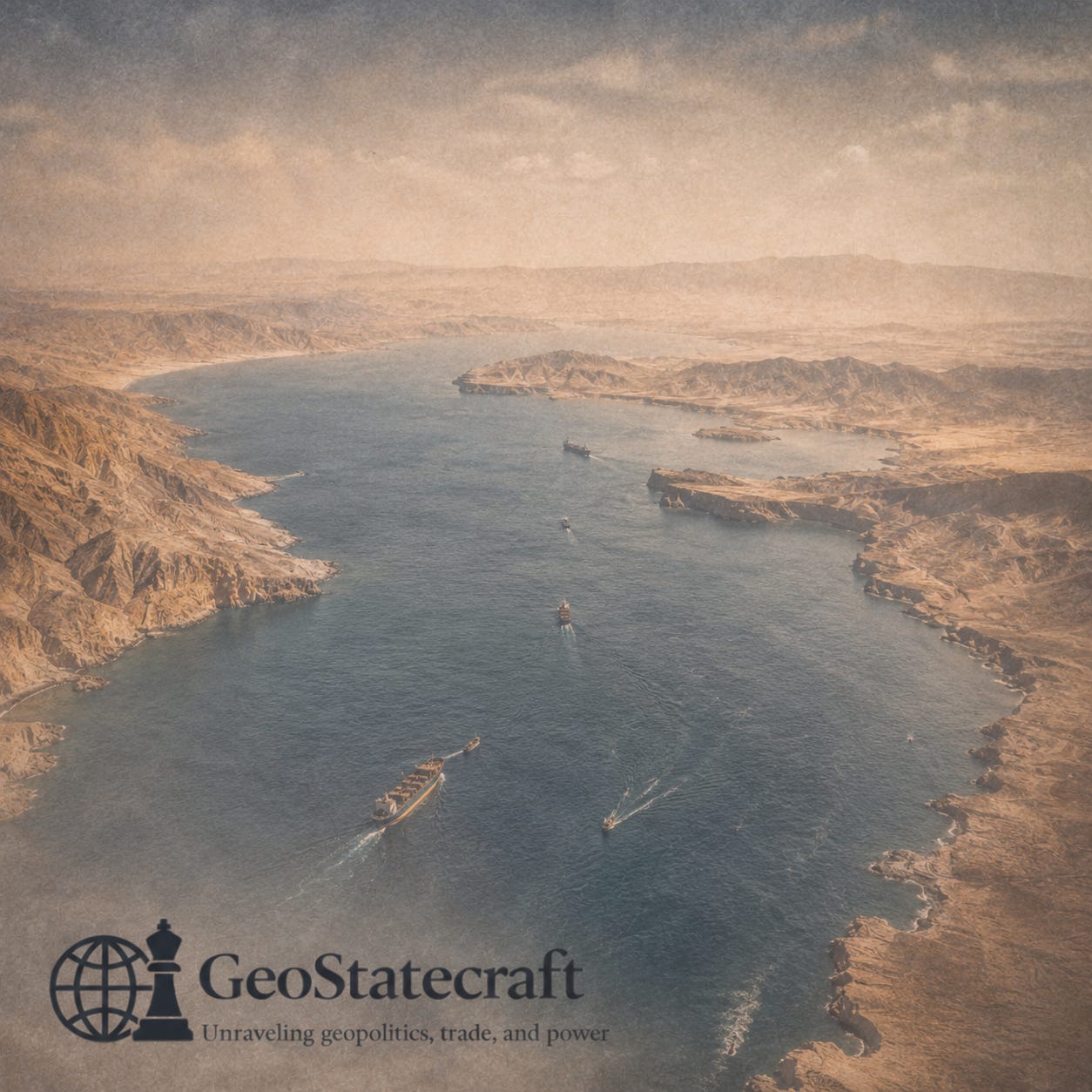
Begin with the number itself. Twenty-one nautical miles is the navigable width of the Strait of Hormuz at its narrowest point. Before February 28, this corridor carried roughly 20 million barrels of crude oil and petroleum products daily, along with a fifth of the world’s LNG, including 93 percent of Qatar’s and 96 percent of UAE’s LNG, with no viable alternative export route. The disruption has been characterized as a severe supply shock with analysts comparing its scale to the oil crises of the 1970s. That assessment, accurate as it is, has a way of making this seem like a problem of scale. A very large disruption requiring a very large response. It is not. This is a problem of structure. For decades, the global economy concentrated roughly a quarter of its seaborne oil and nearly one-fifth of its global LNG trade through a 21-nautical mile corridor in one of the world’s most chronically contested neighbourhoods. Nobody chose this as a strategy. It accumulated, year after year because the assumption of access held. It no longer holds and the world that is being built in the wake of this crisis will not resemble the one that preceded it.
1. The Optimism Trap
The international response has been, in technical terms, without precedent. The IEA coordinated the release of 400 million barrels from the strategic reserves of member nations. The largest release since the institution’s founding. Japan, whose refiners source roughly 95 percent of their crude from the Middle East and route approximately 70 percent of that through Hormuz, committed 80 million barrels from national stockpiles. These numbers are reflective of the seriousness of the issue at hand. They, however, do not communicate adequacy. Global consumption runs at approximately 100 million barrels per day. The entire coordinated reserve release covers just four days of demand. Strategic petroleum reserves were designed to buffer a supply disruption. They were not designed to outlast one of indefinite duration.
The response, however, has exposed the governance structure that lies beneath. The IEA remains, by constitutional design, an OECD institution. China and India, the world’s largest and third largest oil importers that are both acutely reliant on Hormuz flows, hold associate membership. They receive information and they do not shape decisions. Rystad Energy has estimated that more than 70 percent of the world’s population lives in countries without adequate oil buffers. The sustainable Development Policy Institute’s Khalid Waleed captures the reason with precision: strategic reserves require capital to build, finance, fill, rotate and maintain. For governments simultaneously managing foreign exchange constraints, external debt obligations, food import bills and energy subsidies, that capital competes directly with fiscal survival. The Asian Development Bank has already cut its 2026 growth forecast for the region’s developing economies from 5.1 percent to 4.7 percent. This figure will move again. The UN Secretary-General António Guterres, speaking in Nairobi on May 11, was clear: roughly 13 percent of Africa’s imports of oil and fertilizers move through Hormuz, urea prices have risen more than 35 percent in a month at the height of planting season and the risk of a serious food security crisis in 2027 is now a live policy concern. The gap between who absorbs the energy shock and who governs the mechanisms to manage one is, in itself, one of the defining geopolitical fault lines this crisis has exposed.
2. Geography as Destiny
Parallel to the diplomatic stalemate, there is something more durable underway. There is a forced, improvised and partly permanent construction of alternative energy corridors. While they differ in scale and viability, they point in a single direction.
Japan’s receipt this week of its first Azerbaijani crude cargo since the war began is worth pausing on. A tanker carrying approximately 45,000 kilolitres of Azeri Light, which routed through the Baku-Tbilisi-Ceyhan pipeline to Turkey’s Mediterranean port of Ceyhan and from there eastward, arrived at ENEOS’s Negishi refinery in Yokohama. Japan built its entire post-war refinery infrastructure around the processing specifications of Persian Gulf crude. That was rational for sixty years. It is now a strategic liability being unwound, under duress, one cargo at a time. The American Foreign Policy Council has tracked the Trans-Caspian corridor for two decades as a viable but chronically under-utilized alternative to Gulf supply, hemmed in by landlocked geography, chronic underinvestment and a gatekeeping leverage of larger powers. It must be, therefore, understood that the current crisis has not created this route. It has simply removed every remaining justification for avoiding it.
North America’s Pacific corridor is also moving, in ways that deserve more attention than they have received. Ship-tracking data shows two Alaska North Slope tankers departed Valdez for Asian markets within a single month. This matches total Asia-bound shipments from that terminal across all of 2025. The Washington delivered approximately 760,000 barrels to South Korea’s Daesan refinery. The Maritime Glory followed shortly after, departing Valdez laden with approximately 700,000 barrels, bound for Indonesia. Aaron Brady, S&P Global’s executive director for oil markets, sees these shipments as the leading edge of a broader and sustained redirection of Alaskan crude towards Asian markets. The underlying structural case extends well beyond this crisis. Alaska’s Pikka and Willow fields are projected to significantly expand North Slope output over the next decade, while accelerating California refinery closures are steadily reducing the West Coast’s capacity to absorb that crude. The crisis has provided the price signal. The infrastructure trend will sustain the redirection whether or not Hormuz reopens, because the economics will hold regardless.
Iran’s own response is, analytically, the most revealing development of the past two months and as expected, the least reported. Tehran has activated overland corridors through Pakistan, Turkey, Armenia and Azerbaijan, resumed Caspian Sea shipping to Bandar Anzali via Russian, Kazakhstani and Turkmenistani intermediaries and is exporting oil by rail to China. Johns Hopkins economist, Steve Hanke, notes that these overland Caspian routes cannot replace the efficiency of maritime container shipping and will add costs. The framing, however, misses what Tehran is actually attempting. Iran is not trying to reconstruct its pre-war trade architecture. It is trying to remain economically functional long enough to outlast the blockade on politically acceptable terms. A state with 700 kilometres of Caspian coastline, land borders with seven countries and a committed anchor buyer in Beijing has considerably more operational resilience than a naval cordon assumes. The IRGC has now formally redeclared the strait a “vast operational area”. Iran is by no means being defensive and is in fact institutionalizing its position and not retreating from it.
Then there is the fourth corridor, the overland bypass infrastructure meant to link the Gulf to European and Asian markets. RSIS has catalogued the serious ideas. Turkey’s Four Seas Project, revived in April by Foreign Minister Hakan Fidan is one. A proposed Turkey-Qatar gas pipeline is another idea. A Saudi-UAE overland bypass routing crude from Dammam to Khorfakkan on the Gulf of Oman as another proposed plan. Saudi Arabian Railways announced five new freight corridors in April expanding access to Red Sea ports. All of these proposed plans are real, but none are close. These are decade-long construction projects being discussed with the urgency of a five-week crisis and the gap between ambition and delivery is itself part of the story. These alternatives require high levels of regional economic integration, strategic trust and institutional cooperation that are currently impeded by sectarian rivalries, limited fiscal capacity in transit states and accumulated political grievances.
3. China’s Calculated Exposure
No actor in this crisis carries a more structurally exposed position than China and none have managed that exposure with more deliberate ambiguity. Beijing entered the blockade holding approximately 1.4 billion barrels in strategic and commercial crude inventories which sums up to roughly 220 days of Middle East import equivalency. This buffer was built over two decades in conscious anticipation of precisely this scenario. It has bought time. It has not resolved the underlying problem. Around 52 percent of China’s oil imports and approximately 30 percent of its LNG supply transit Hormuz.
The Saratoga Foundation’s analysis is direct about what the crisis is accelerating. The blockade functions as a catalyst, pushing China’s energy strategy further toward continental suppliers and overland transport corridors. When Russia’s Foreign Minister Lavrov met Xi Jinping on April 15 and explicitly offered to compensate for Chinese shortfalls from restricted Iranian supply, that offer landed on ground already being prepared. The Central Asia-China Gas Pipeline, three operational lines linking Turkmenistan, Uzbekistan and Kazakhstan, delivers approximately 55 billion cubic metres annually. Turkmenistan signed a new CNPC agreement in March for processing facilities handling an additional 10 bcm. The long-delayed Line D expansion, projected to add 25 to 30 bcm via Tajikistan and Kyrgyzstan, remains stalled by financing constraints and transit negotiations that themselves reflect an uncomfortable asymmetry. China has less urgency to lock in terms than Russia does to offer them. This is primarily because Russia faces shrinking buyer alternatives under Western sanctions.
China’s strategic problem, actually, lives in this asymmetry. The continental pivot does not eliminate and in fact only relocates and reshapes energy vulnerability. Deepening pipeline dependence on Moscow introduces leverage into a relationship that is simultaneously competitive across multiple strategic domains. Beijing is consciously trading maritime chokepoint risk for overland supplier concentration risk and it is quite clear-eyed about the exchange that it is making. The clearest evidence of that clarity is China’s diplomatic positioning on Hormuz itself. US Treasury Secretary Scott Bessent stated publicly on May 14 that China has a much larger interest in reopening the strait than the United States does and would work behind the scenes toward that end. Iranian Foreign Minister Araghchi travelled to Beijing on May 6, briefed Wang Yi directly on the negotiating situation and sought Chinese support for a post-war regional framework. Wang called for an immediate end to hostilities and urged reopening the strait as soon as possible. China is not a background presence in this resolution. It is a key structural variable that Washington is now depending on to help resolve a crisis its own military operations helped precipitate. This itself explains to you most of what you need to know about the current impasse.
4. The Negotiating Trap
The diplomatic picture as of mid-May 2026 is one of managed stalemate with visible fractures on both sides. The United States has moved substantially from its opening position. Secretary of State Rubio declared Operation Epic Fury “concluded” on May 6 and reframed Washington’s objective as a memorandum of understanding for future negotiations. This is exactly the sequencing Tehran had demanded from the outset: end the war and reopen the strait first and address the nuclear programme later. Trump paused Project Freedom, the US-guided transit corridor intended to clear stranded vessels, citing progress in talks. As of this writing, over 1,550 commercial vessels remain stranded in and around the strait, with 22,500 mariners trapped aboard them. This figure was confirmed by the Chairman of the Joint Chiefs of Staff on May 6.
Iran’s counter position is internally coherent, if diplomatically maximalist: reopen the strait, lift the blockade and end the war in exchange for agreeing to talk about the nuclear programme later. Tehran is also pressing for formal recognition of Iranian sovereignty over Hormuz. This is a demand that goes well beyond anything Washington can concede without legitimizing the closure of an internationally recognized waterway. Iranian Foreign Minister Araghchi has been explicit that nuclear enrichment is non-negotiable at this stage. A senior Iranian lawmaker dismissed the Axios-reported US framework as unrealistic. The IRGC, separately, has said that the strait will not be opened to enemies of the Islamic Republic. These negotiating positions are not designed to converge quickly. Pakistan, which has been mediating actively and with apparent seriousness, expressed hope for an agreement sooner rather than later on May 6. That hope remains unresolved.
What is clear is that the resolution timeline will be determined as much by the US-China back-channel and Pakistan’s mediation capacity as by any direct exchange between Washington and Tehran.
5. What does Not Return
The Strait of Hormuz will reopen, through negotiation, military resolution or some combination of both. The energy order it underpinned will not be restored. Without being dramatic, this is a structural observation on how permanently price signals, procurement strategies, infrastructure investments and institutional reform pressures move once a shock of this scale forces them into motion.
Asian energy procurement is diversifying away from single-corridor Gulf dependence. This is being done as a compulsion, rather than as a preference, being institutionalized into long-term contracting, reserve policy and infrastructure capital allocation. Rystad Energy’s recommendation of a 120-150 days reserve standard, against the IEA’s current 90-day requirement has moved into the active policy discussion zone from the academic in several Asian capitals. The IEA’s governance architecture faces reform pressure it cannot absorb indefinitely. An OECD institution constituted to manage global supply disruptions that formally excludes the world’s two largest energy consuming growth economies has just presided over the worst supply chain disruption in recorded history. The political conditions for structural reform now exist in a way that they previously did not.
Central Asia’s strategic weight has been permanently recalibrated. Kazakhstan, Azerbaijan and Turkmenistan have a price signal and an investment window that will not recur on comparable terms. The AFPC has documented two decades of that region’s landlocked producers constrained by geography, gatekeeping neighbours and inadequate infrastructure investment. The crisis has compressed that structural transition, not completed it but materially advanced it. Whether the capital flowing into Trans-Caspian infrastructure over the next five years is predominantly Chinese or whether Gulf and Western investors find the political and commercial urgency to compete, is one among the most consequential open investment questions of the post-crisis period.
Twenty-one nautical miles revealed this realignment. The vulnerabilities associated with it such as those of energy logistics being concentrated in a single corridor, of a governance architecture designed for a world that no longer exists, of reserve buffers that leave the majority of humanity unprotected, had been accumulating for decades without forcing a reckoning. The blockade has forced one. What follows will be more fragmented, more expensive to sustain and more resistant to single-point disruption than what preceded it. These are characteristics of a new order being written in the midst of an active blockade, whose terms will be very difficult to revisit once the strait reopens and the urgency dissipates. The window to understand and act on this is narrower than it appears.
References:
· Alaska Beacon. (2026, May 13). More Alaska crude flows to Asia as Strait of Hormuz stays shut.
https://alaskabeacon.com/2026/05/13/more-alaska-crude-flows-to-asia-as-strait-of-hormuz-stays-shut/
· Al Jazeera. (2026, May 12). Global energy crisis highlights meagre oil buffers in developing world.
· American Foreign Policy Council. (2020, May 31). The Evolution of Central Asian Energy.
https://www.afpc.org/publications/articles/the-evolution-of-central-asian-energy
· Dzulhisham, H.E. (2026, April 29). Alternatives to Hormuz: How to Export Oil and Gas from the Persian Gulf (CO26093). S. Rajaratnam School of International Studies.
https://rsis.edu.sg/rsis-publication/rsis/co26093/
· New York Post. (2026, May 13). Iran using Caspian Sea, highways and a railroad to China to bypass US’ Strait of Hormuz blockade.
· Reuters. (2026, May 11). Japan to receive first Central Asian crude oil since Iran war started.
· Saratoga Foundation. (2026, May 13). Hormuz Blockade Pushes China Toward Continental Energy Suppliers and Overland Routes.
· Al Jazeera. (2026, May 6). Has the US accepted Iran’s demand to settle Hormuz first, nuclear later?
· Al Jazeera. (2026, May 7). What are US proposals to end war, and will Iran agree to them?
https://www.aljazeera.com/news/2026/5/7/what-are-us-proposals-to-end-war-and-will-iran-agree-to-them
· NPR. (2026, May 7). Pakistan says it’s hopeful a U.S.-Iran deal can happen soon.
https://www.npr.org/2026/05/06/nx-s1-5813497/iran-war-strait-hormuz-updates
· Times of Israel (2026, May 6). US, Iran said closing in on framework for permanent deal, as Trump renews bomb threats.
· United Nations News. (2026, May 11). Strait of Hormuz de-escalation is urgent, says UN chief.
https://news.un.org/en/story/2026/05/1167478
· Al Jazeera. (2026, May 6). China calls for end to Iran war and Hormuz to reopen during Araghchi visit.
https://www.aljazeera.com/news/2026/5/6/irans-araghchi-holds-talks-with-chinas-wang-yi-in-beijing
· EFE. (2026, May 10). Iran warns of tougher Hormuz controls over US sanctions.
https://efe.com/english/latest-news/2026-05-10/iran-strait-of-hormuz-sanctions-threat/
· Reuters. (2026, May 14). China will do what it can to reopen Strait of Hormuz, Bessent says.
· U.S. Energy Information Administration (EIA). (2012, January 4). The Strait of Hormuz is the world’s most important oil transit chokepoint.
https://www.eia.gov/todayinenergy/detail.php?id=4430#
· The National News. (2026, April 7). The 21-mile gap in international law that could reshape the global order.
https://www.thenationalnews.com/opinion/comment/2026/04/07/hormuz-international-law/
